
From Ash Stand to Wetland
.jpg)
A major benefit of watershed-scale restoration is understanding how water moves across the landscape and finding ways to slow it down, enable it to soak in, and to filter that water before it reaches downstream systems and Lake Huron.
In 2023, a conversation with 18-Mile watershed farmer Murray Lotton led to an exciting restoration opportunity on his farm.
After Emerald Ash Borer impacted many of the Ash trees on Murray’s farm, he contacted the Pine River Watershed Initiative Network (PRWIN) to explore options for restoring the affected area.
During a site visit, Murray asked whether a wetland could be created where the dead Ash had stood.
When asked what made him want to create a wetland, he answered that: “We wanted to keep water on the property longer, improve the habitat and hopefully bring the ducks back.”
Staff from Maitland Valley Conservation Authority (MVCA) and Ducks Unlimited Canada (DUC) helped to identify a suitable section of pasture and began developing a plan.
By 2026, the project came to fruition. MVCA was able to combine funding from multiple sources including the Ontario Ministry of the Environment, Conservation and Parks; the Resilient Agricultural Landscape Program; Ducks Unlimited Canada; and Maitland Conservation Foundation to cover 100 per cent of the project costs.
By combining funding from the different programs, MVCA was able to turn Murray’s restoration idea into a completed wetland without requiring an out-of-pocket contribution from the landowner.
“I’d like to see healthy soil, clean water, good pasture, healthy livestock, and lots of wildlife,” Murray said. “Hopefully there are ducks back on the wetland, deer in the bush and plenty of life around the farm. Most of all, I’d like the farm to be in better shape then when we got it.”
The new headwater wetland will hold, settle, and filter water, helping reduce runoff to improve water quality throughout the watershed. It will also provide valuable habitat for waterfowl, frogs, turtles, and mammals, and contribute significantly to carbon storage.
The project is set to be completed with a buffer of native species of trees and shrubs planted around the wetland basins in 2027 with the help of the Pine River Watershed Initiative Network.
Projects like Murray’s demonstrate how restoring wetlands in the headwaters can create benefits throughout an entire watershed and ultimately contribute to a healthier Lake Huron. MVCA staff are currently looking for wetland projects like Murray’s and eligible projects on farmland may qualify for funding up to 100 per cent.
Reach out to learn what might be possible on your property.
This project is funded, in part, by the Governments of Canada and Ontario under the Sustainable Canadian Agricultural Partnership, a five-year, federal-provincial-territorial initiative.
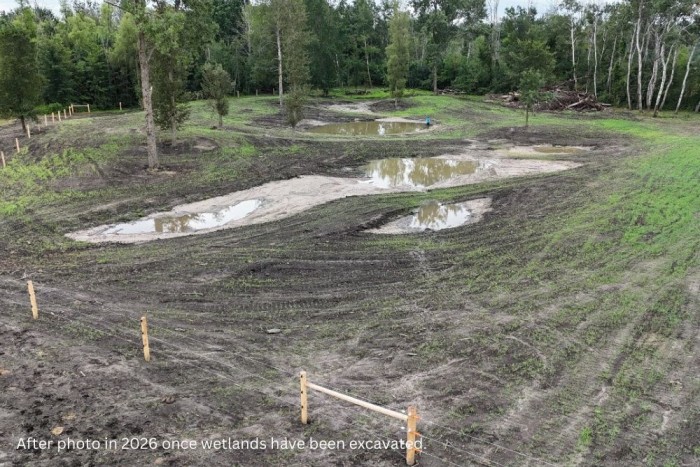
After photo in 2026 once wetlands have been excavated.