
Septic maintenance vital in Karst area
.jpg)
How Karst Hydrology Affects Water Quality and the Bruce Peninsula Biosphere Association’s Septic Incentive Program
The Saugeen (Bruce) Peninsula contains the most developed and extensive Karst landscape in Ontario.
Karst geology is formed in areas rich in carbonate bedrock such as limestone and dolostone.
The gradual dissolving of the bedrock enlarges existing fractures, creating underground streams and conduits beneath the surface.
Groundwater flow has enhanced flow speed within the underground network due to the wider pathways compared to non-Karst aquifers where water moves through a porous medium at slower speeds.
Surface water enters these networks through pathways including streams that transition to groundwater (sinking creeks), precipitation infiltrating through soil (direct recharge), and direct inflows through cracks in exposed bedrock.
Water travels through the Karst networks at much faster rates than in traditional aquifers, resulting in Karst aquifers being designated highly vulnerable. This rapid infiltration of surface water into Karst aquifers significantly reduces the natural filtration of contaminants as water infiltrates through the soil.
As the water flows directly into the network of underground streams carrying any contaminants it encounters as it flows across the surface including bacteria, microorganisms and nitrates.
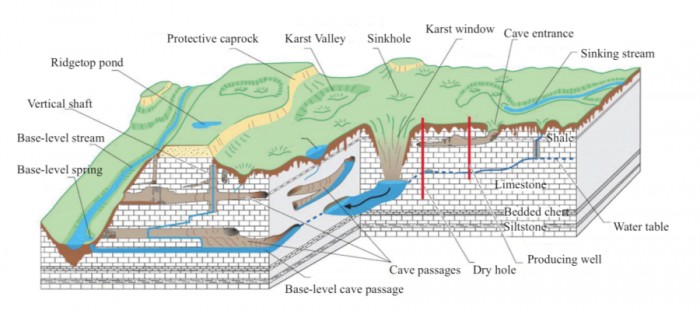 Physiographic and hydrologic features of well-developed Karst terrain (Taylor & Greene USGS, 2008).
The highly Karst geology of the Bruce Peninsula increases the vulnerability of the aquifers on which communities rely or drinking water.
In 2012, with the recognition that water quality is fundamental to ecological and human health, and through the support of the Ontario Ministry of the Environment, Conservation, and Parks (MECP), and partners in the community, the Bruce Peninsula Biosphere Association (BPBA) began the Six Streams Initiative to monitor and improve water quality on the Bruce Peninsula and Lake Huron.
On the Bruce Peninsula, maintaining water quality is critical for protecting Lake Huron and the rare peninsula ecosystems, and the health of residents and visitors.
BPBA’s Septic Incentive Program, part of the Six Streams Initiative, is focused on improving water quality by supporting home owners in completing routine maintenance of their septic systems through covering the cost of the pump-outs and inspections.
Pump-outs are critical to the health and longevity of septic systems since solid waste (black sludge) will build up in the tank until it is forced out into the tile bed and completely clogs the system. This can force water back out of the tank into your residence or cause leaking.
Inspections are another critical aspect since they reveal issues such as cracked tanks, roots clogging tile beds, clogged effluent filters among others.
Healthy septic systems and replacing damaged systems are critical to maintaining high water quality, especially in areas of Karst topography.
Cracked septic tanks can allow black sludge and associated bacteria to directly enter the aquifer. Failed tile beds clogged by roots can force effluent released by the tank to flow across the surface entering nearby waterways, infiltrating through nearby bedrock faults, backflow into the tank or pools of effluent on the surface. In addition, failed tile beds that have shifted or misaligned will not release effluent evenly into the designed material that filters the effluent through bacteria and organisms.
Uneven effluent releases can overwhelm the filtration process and result in incompletely treated effluent flowing down towards the bedrock.
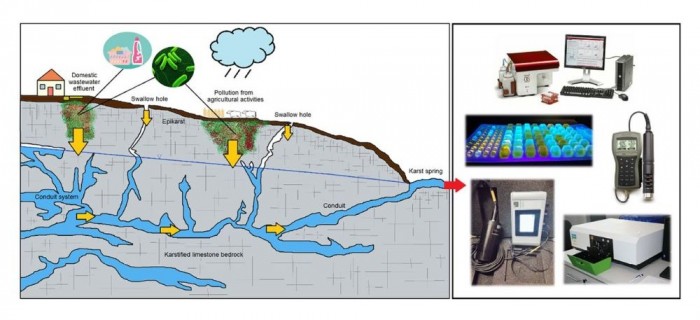
Effluent from Residential and Agricultural sources on Karst systems (Vucinic, et al., 2023, Journal of Contaminant Hydrology).
Beyond the risks Karst hydrology presents for residential drinking water, enhanced subsurface networks of water flows increase risks for the critical ecosystems of Lake Huron.
Nutrient and bacterial loading from agricultural, septic and other sources can flow through the Karst hydrology directly to Lake Huron causing algal blooms and bacteria concerns.
Pharmaceuticals are not remediated through typical septic systems, and failing septic systems can introduce these contaminants into surface or groundwater, with transport to Lake Huron enhanced in the Karst systems of the peninsula.
Together, these factors highlight the importance of the BPBA’s Septic Incentive Program and water quality monitoring completed through the Six Streams Initiative.